Technical guide
Automatic Linux server recovery without creating a reboot loop
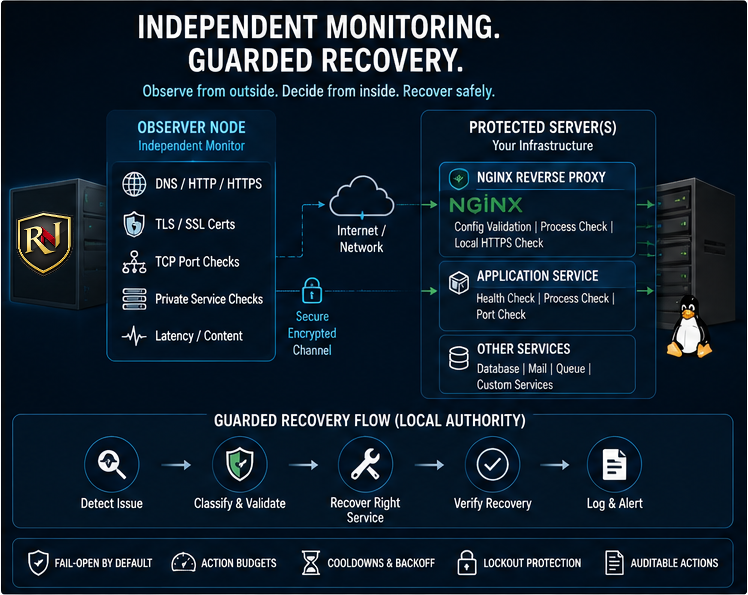
Reliable recovery requires more than restarting a process whenever an uptime check fails. A safe design separates observation from authority and assumes the network path can fail independently of the server.
Why remote monitoring is not enough
A public HTTP failure can be caused by DNS, an ISP, NAT, a firewall, a switch, routing, TLS, Nginx, a backend application, or the server itself. Rebooting from one failed request risks converting a network incident into a server incident.
Use a separate observer
An independent host should check public URLs, certificates, DNS answers, content, latency, redirects, and private service ports. It should classify symptoms and notify operators, but its inability to reach a server should not automatically grant reboot authority.
Make recovery decisions locally
The protected server can inspect Nginx configuration, process state, systemd status, listening ports, and a local HTTPS request using the production hostname. It can restart the affected service, retest it, and escalate only when the local failure persists.
Separate Nginx and application recovery
A reverse proxy can be healthy while an upstream application is unavailable. Restarting Nginx cannot repair every application failure, and restarting an application cannot repair an invalid proxy configuration.
Each service should have its own health evidence, validation steps, restart action, cooldown, and recovery budget.
Use systemd without relying on it alone
Systemd restart policies are useful for process crashes, but a process can remain running while the service it provides is unhealthy. Recovery decisions should combine process state with functional checks.
Prevent feedback loops
Use consecutive-failure thresholds, exponential backoff, restart and reboot budgets, cooldown periods, persistent state, and automatic lockout. Once the system exhausts its safe recovery budget, it should leave the condition unchanged and request human review.
Protect against a complete operating-system freeze
A hardware watchdog can reset a host that stops servicing the watchdog timer. This is distinct from network monitoring and remains effective when userspace or the kernel becomes unresponsive.
A watchdog should not replace service-level recovery. It is a separate last-resort mechanism for a class of failures that ordinary service checks cannot correct.
Choose fail-open when evidence conflicts
For small self-hosted environments, the safer default is usually: when the system cannot establish what failed, alert and leave the server running. Disruptive remote action should require multiple independent signals and explicit authorization.
Test refusal as carefully as recovery
Recovery testing should confirm successful restarts, but it should also confirm that ambiguous remote failures, invalid configurations, exhausted action budgets, and conflicting evidence do not trigger unsafe repetition.
For reverse-proxy-specific guidance, read the Nginx monitoring and automatic recovery guide.
For resolver and split-DNS failures, read the DNS monitoring and split-DNS troubleshooting guide.
For service-level recovery, read the systemd service monitoring and automatic recovery guide.
For certificate validation and expiration alerting, read the SSL certificate monitoring and TLS expiration alerting guide.
For a layered view of Linux infrastructure health, read the Linux server health monitoring guide.
Read the complete RecoverNode testing and safety methodology.
Need this installed and tested?
RecoverNode combines an independent observer with guarded local recovery for Linux, Nginx, and application-service environments.