Product origin
Monitoring reported the outage. It could not safely decide what to do next.
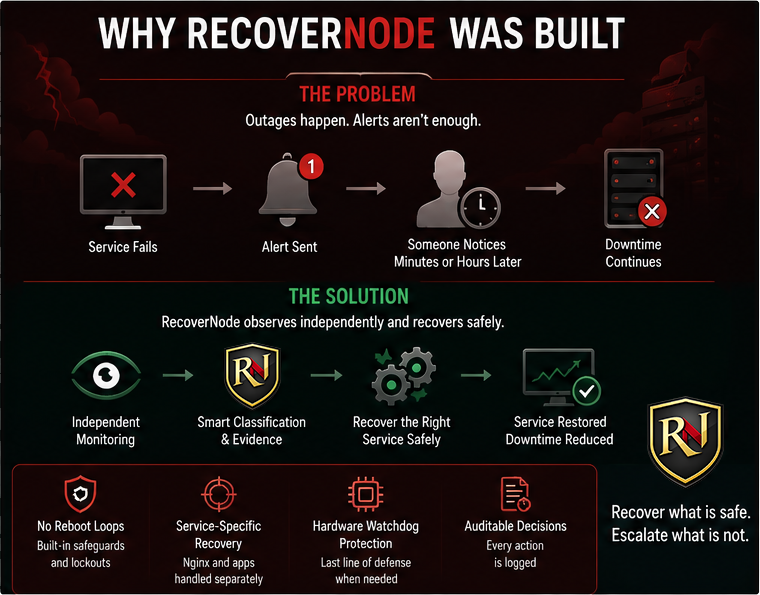
RecoverNode began after an unattended infrastructure failure exposed the difference between detecting downtime and recovering from it safely.
The original failure
A Linux server hosting public web services became unavailable while its operator was away. External monitoring could report that the sites were down, but the report did not identify whether the failure was caused by the public network path, the reverse proxy, an upstream application, the operating system, or the server hardware.
A remote reboot might have restored service. It might also have rebooted a healthy server during a DNS, routing, firewall, ISP, or monitoring failure.
The dangerous shortcut
The obvious response is to connect an uptime failure directly to a restart or reboot command. That design is simple, but it gives a remote observation more authority than the observation can justify.
A failed HTTP request proves that one request did not succeed. It does not prove which component failed, whether the target server is unhealthy, or whether restarting it will correct the problem.
Auto-restart versus guarded recovery
Safe automatic recovery is not the same thing as auto-restart. A simple restart loop reacts to a failed check. RecoverNode requires the evidence to support a specific action and deliberately reduces its authority when the failure is ambiguous.
The architecture that followed
RecoverNode was designed around two separate perspectives. An independent observer checks DNS, TLS, HTTP behavior, public endpoints, private addresses, and service ports. Local guards inspect the protected host from inside the system.
The observer provides evidence and alerts. The local guard validates configuration, process state, and local service behavior before it restarts a service. A remote observation does not directly authorize a reboot in the default architecture.
Why recovery must have limits
Even a correct recovery action can become dangerous when it repeats. RecoverNode therefore uses consecutive-failure thresholds, escalating backoff, cooldown periods, restart and reboot budgets, persistent state, and automatic lockout.
Once the safe recovery budget is exhausted, the system stops taking disruptive action and requests human review. The goal is not to make automation relentless. The goal is to make it appropriately restrained.
What the power failure clarified
A later Raspberry Pi outage demonstrated another important boundary: software cannot recover a computer that does not receive enough power to complete startup. A watchdog is useful only after the hardware, firmware, kernel, and operating system are running well enough to service it.
RecoverNode therefore treats supported Raspberry Pi power-health data as evidence to preserve and report. Current or historical undervoltage and throttling flags can trigger rate-limited alerts, but they do not authorize repeated reboots of a machine with an unstable power source.
What RecoverNode became
The original recovery design expanded into a guided product that discovers server roles and supported hardware capabilities, creates the required configuration, installs the correct observer and guard components, optionally adds supported Raspberry Pi power-health reporting, validates the deployment, reports status, and provides rollback and uninstall tools.
The same principle remains at the center of the product: uncertainty should reduce automation authority rather than increase it.
See how the design is tested
The testing methodology covers failure simulation, false-positive resistance, recovery budgets, lockout, rollback, backups, and operational verification.